
L|A|L.2 - Access to Diverse Cultural Expressions in Theatre
12 January 2026 at Under the Radar
LINCOLN CENTER FOR THE PERFORMING ARTS
New York City, USA
The second edition of L|A|L (“L|A|L.2”) is produced in cooperation with Under The Radar Festival, HowlRound Theater Commons, the Lincoln Center for the Performing Arts, and the German Commission of UNESCO. It will be held at the Kenneth C. Griffin Sidewalk Studio, David Geffen Hall, Lincoln Center.
Like each L|A|L, the second edition focused on one field of the performing arts—the global theater ecosystem. And like each L|A|L, the second edition contemplated fairness through the frame of one of the principals outline in the “Fair Culture Charter,” in this case Principle #2: “access to diverse cultural expressions and resources,” which draws heavily on the UNESCO’s 2005 “Convention on Diversity of Cultural Expressions.”
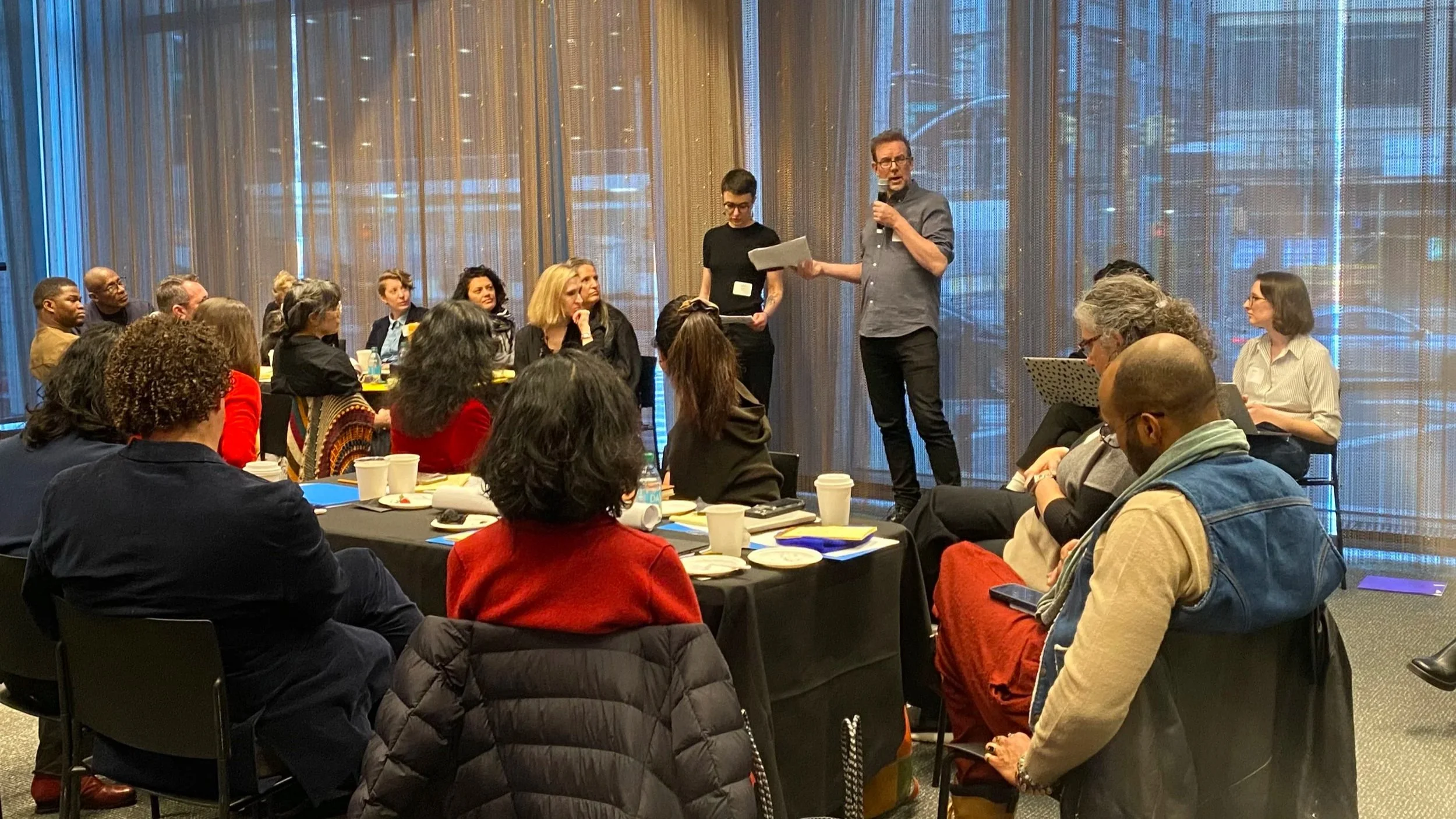
L|A|L.2 brought together 32 thought leaders from across the global cultural ecosystem—from five continents and fifteen countries—to design initiatives that promote the capacities of the theater sectors in disadvantaged communities, nurture culture and arts education, encourage international theater enterprises to follow fair practices, and foster respectful cross-cultural engagement.
-
Joshua Alabi (Nigeria)
Alia Alzougbi (UK)
Debora Balardini (Brazil / France / USA)
Marc Bamuthi Joseph (USA)
Jamie Bennett (USA / Canada)
Bill Bragin (USA / UAE)
Sami Daoud (Egypt / UK)
Martine Dennewald (Luxembourg / Canada)
Rita Ezenwa-Okoro (Nigeria)
Susan Feldman (USA)
Héctor Flores Komatsu (Mexico / USA)
Boo Froebel (USA)
Lynn Fu (China / USA)
Jamie Gahlon (USA)
Fizza Hasan (Pakistan)
Rika Iino (USA)
Mara Isaacs (USA)
Thomas O. Kriegsmann (USA)
Barbara Lanciers (USA)
Laura Mackenzie Stuart (Scotland)
Jonathan McCrory (USA)
Dr. Keith Nurse (Trinidad and Tobago)
Jeffrey Omura (USA)
Zeyba Rahman (USA)
Tanya Selvaratnam (USA)
Sachiko Soro (Fiji Islands)
Caitlin Strokosch (USA)
Shanta Thake (USA)
Jenny Tibbels (USA)
Cynthia J. Tong (USA)
Adrienne Wong (Canada)
-
L|A|L.2 was structured around a plenary conversation and breakout discussions.
During the breakout session, fellows were tasked to imagine strategies for implementing Principle #2 of the Fair Culture Charter, which calls for promoting access to diverse cultural expressions. The Charter identifies four types of initiatives that achieve this goal, so through the lens of the global theater ecosystem, our goal was to imagine initiatives that realize these four implementation goals:
Initiatives that promote theater capacities in disadvantaged communities,
Initiatives that promote theater education, audience outreach, and engagement,
Initiatives that promote fair business practices in the theater sector, and
Initiatives that promote respectful cross-cultural engagement in the theater sector.
We have assembled a short (and definitely not exhaustive) list of initiatives that have been tried to aim for similar goals. Find them all in our dedicated Compendium.
-
L|A|L.2 was an inspiring, thoughtful, well-organised, and highly valuable space for meaningful dialogue across sectors, regions, and professional backgrounds. The fellows brought forward a shared concern with power imbalance, inequity, artist protection, reciprocity, and the need for long-term, relationship-based support systems.
From recurrent issues to innovations and investigations, the report of L|A|L.2 brings together a vast array of ideas to give meaning to fairness in the theater sector.
-
During L|A|L.2, we look into Principle #2 of the Fair Culture Charter: “Access to Diverse Cultural Expressions and Resources.” Here is the text reproduced from the Charter itself:
Everyone has the right to enjoy access to diverse cultural expressions and resources. In the digital environment, accessibility extends beyond mere availability and affordability; it requires discoverability of diverse content in different languages. It also entails bridging the digital divide and ensuring equal access to cultural resources that enable engagement in content creation, production, dissemination and distribution.
Accessibility requires a special emphasis on culture and arts education, as well as cultural awareness from the earliest age. They should be integrated at all levels of learning, should be made available to young people regardless of their socio-economic status, and encourage the availability and creation of cultural and artistic spaces specifically designed for children and young individuals.
These are responsibilities of all stakeholders, including public authorities, and multinational enterprises that need to apply a due diligence standard. It requires a commitment from public and private organisations to identify and address inequalities and obstacles that may prevent access and participation.
Accessing diverse contents should be done in a respectful way, particularly in cases where content concerns under-represented, minority or marginalized communities. Indigenous peoples require particular attention, as do afro-descendant communities. Such respect involves refraining from usage of others’ cultural expressions – in ways that may constitute cultural appropriation – without prior informed consent and just compensation, while recognising the need for balanced cultural exchange.
Click here for the full text of the Fair Culture Charter.
Hosts, Advisors, Collaborators
The second edition of Live|Arts|Lab is a collaboration between Marie Fol and Tamizdat with Under The Radar Theatre Festival, HowlRound Theatre Commons, Lincoln Center for the Performing Arts, and the German Commission for UNESCO, with the support of Sepehr Sharifzadeh (Iran / France), Sophie Dowden (UK / France) and Boo Froebel (USA).
Curator, producer, festival maker, and cultural intermediary based in France, Sepehr Sharifzadeh works at the intersection of performing arts, policy, and international collaboration, connecting artists and institutions across geographies.
Sophie Dowden is a freelance consultant for European cultural projects and policy, with two main focuses: DEI&B (diversity, equity, inclusion and belonging) and mental health. Her expertise lies in project management, facilitating processes, policy development and workshops, as well as contributing to research and reports.
Producer, curator, and creative consultant based in New York, Boo Froebel is currently Director of the Democracy Cycle at PAC NY. Prior to that role, Froebel worked as General Manager of Tamizdat.
UNDER THE RADAR FESTIVAL
For over two decades, the Under the Radar Festival has brought bold, risk-taking work to New York City, celebrating groundbreaking theater and performance from around the world and just down the street. Produced in collaboration with dozens of venues at a selection of historic and emerging theaters across New York City, the festival showcases innovative multidisciplinary artists whose work speaks powerfully to the present moment. Under the Radar’s influence sets a cultural standard that resonates through the artistic landscape far further and beyond its January schedule. In coordination with Festival founder and Director Mark Russell, Producers Thomas O. Kriegsmann and Sami Pyne of ArKtype, and with the addition of this year’s highly-esteemed Co-Creative Directors Meropi Peponides and Kaneza Schaal, UTR is positioned to continue to capitalize on the Festival’s rich history and expand on a tradition of trailblazing new direction. The 21st edition of UTR will run from January 7-25, 2026 presenting over 32 productions at various partner organizations across the city.

HOWLROUND THEATRE COMMONS
HowlRound Theatre Commons is a free and open platform for theatremakers worldwide that amplifies progressive, disruptive ideas about the art form and facilitates connection between diverse practitioners. Using a commons-based approach, HowlRound invites open participation around shared values and envisions a theatre field where resources and power are shared equitably in all directions, contributing to a more just and sustainable world. For more information visit howlround.com.
LINCOLN CENTER FOR THE PERFORMING ARTS
Lincoln Center for the Performing Arts (LCPA) is a nonprofit dedicated to ensuring the Lincoln Center campus is a destination that welcomes all—where every visitor, whether a native New Yorker or New Yorker for a day, can find inspiration, artistic innovation, and community in the creative achievements realized on campus. Year-round, LCPA offers robust seasons of programming, representing a broad spectrum of performing arts disciplines and complementing the artistic and educational activities of the 10 fellow resident arts organizations with whom they share a home. LCPA presents hundreds of programs each year, offered primarily for free and Choose-What-You-Pay, helping ensure that the arts are at the center of civic life for all.